Traditional magnetoencephalography has mapped the magnetic fields generated by human brain activity for decades, but it has always been held back by a fundamental physical constraint: liquid helium cryogenics. Superconducting Quantum Interference Device (SQUID) arrays require bulky, vacuum-insulated Dewars that enforce a 2 to 3 cm standoff distance between the scalp and the pick-up coils. Because magnetic signal amplitude follows the inverse-square law, that physical gap sacrifices up to 80% of cortical signal strength.
The rise of the OPM magnetometer bypasses cryogenic cooling entirely. By placing miniaturized alkali vapor cells millimeters from the scalp, modern arrays capture neural dynamics with unprecedented signal-to-noise ratios, tracking movements in pediatric care and cognitive neurology that were once impossible. Achieving high diagnostic sensitivity across wearable helmets hinges on a critical optoelectronic component: a stable, single-mode, narrow-linewidth vertical-cavity surface-emitting laser (VCSEL).
Operating Principles: Alkali Vapor and Resonant Optical Pumping
An OPM detects magnetic fields on the order of tens to hundreds of femtoteslas by measuring how atomic
electron spins interact with magnetic flux. The basic mechanics rely on optical pumping, typically within rubidium ({87Rb) or cesium (133Cs) vapor cells.
Spin Alignment: A circularly polarized beam tuned to the atomic D1 transition line pumps valence electrons into a single spin-aligned ground state, making the atomic cloud optically transparent.
Magnetic Precession: As synaptic currents pass through nearby cortical tissue, the resulting local magnetic field alters the spin orientation of the polarized atoms.
Optical Readout: This precession changes the vapor cell's optical transmission or polarization rotation. A photodiode measures the emerging intensity, translating tiny brain signals into readable voltage traces.
When operated in the Spin-Exchange Relaxation-Free (SERF) regime—where atomic collisions happen faster than spin precession—the system reaches ultra-high sensitivity. Maintaining this condition demands a steady zero-field resonance laser source for medical imaging that does not drift away from the narrow absorption profile.
Why Spectral Linewidth Dictates Signal Quality
Standard telecommunications lasers feature broad spectral distributions spanning tens of gigahertz. In atomic physics, broad beams degrade performance.
The natural absorption profiles of rubidium (795nm) and cesium (894nm) vapor cells are naturally narrow. Off-resonance photons fail to pump atoms into coherent spin states; instead, they cause spontaneous scattering, introduce thermal noise, and trigger power broadening, which widens the magnetic resonance line and blunts measurement sensitivity.
Phase noise in an optical emitter directly converts into amplitude noise as light passes through the dispersive atomic vapor. In quantum biosensing, where signals register at femtotesla levels, laser intensity fluctuations closely mimic neural wave patterns. Narrowing the optical linewidth concentrates photon energy directly within the absorption band, preventing phase-induced noise and protecting the low-frequency signals associated with deep cortical activity.
Laser Diode Architecture: Selecting the Proper Source
Choosing a laser diode for optically pumped magnetometers involves trade-offs between optical purity, power dissipation, footprint, and manufacturing stability.
While external cavity lasers provide exceptional linewidths, their bulk and sensitivity to movement make them impractical for multi-channel caps containing 50 to 100 individual sensor nodes. Distributed feedback (DFB) edge-emitters deliver high output but consume hundreds of milliamperes, shedding unwanted heat near the patient's scalp.
VCSELs offer an ideal balance for wearable arrays. Their vertical-cavity architecture supports a small emission volume with low threshold currents, reducing electrical consumption and simplify thermal stabilization inside compact sensor housing.
Magnetic Cleanliness and Packaging Requirements
Integrating an active optoelectronic component into a sensor designed to measure femtotesla fields creates an inherent physical conflict: the emitter must not generate its own magnetic disturbance.
Standard microelectronic components rely heavily on ferromagnetic materials. Nickel barrier layers prevent gold-tin solder leaching, while Kovar (an iron-nickel-cobalt alloy) matches glass-to-metal thermal expansion. When worn on a moving human head, these ferromagnetic metals create magnetic distortion as they cut through residual ambient fields, easily blinding adjacent vapor cells.
Achieving a clean baseline requires an ultra-low magnetic signature optical package built from scratch:
Lead Pins & Headers: Replace Kovar with high-purity titanium, ceramic, or oxygen-free high-thermal-conductivity (OFHC) copper.
Diffusion Barriers: Omit nickel underplating entirely, using specialized platinum, gold, or copper barrier metallurgies.
Die Attach & Interconnects: Employ high-purity gold wire bonding and non-magnetic conductive epoxies or gold-tin eutectic preforms.
An authentic non-magnetic VCSEL architecture allows the optical source to sit millimeters away from the rubidium cell without introducing offset biases or movement-induced baseline drift.
Engineering Considerations for Scalable MEG Helmets
Deploying hundreds of sensors across a conformable helmet introduces strict requirements for system integration:
For clinics running all-day scanning protocols, wavelength repeatability is essential. Emitters must offer smooth current- and temperature-tuning curves free of sudden mode hops, ensuring the laser remains locked to the atomic absorption peak even as the sensor body warms during operation.
Semiatom GmbH: Tailored Quantum Photonics
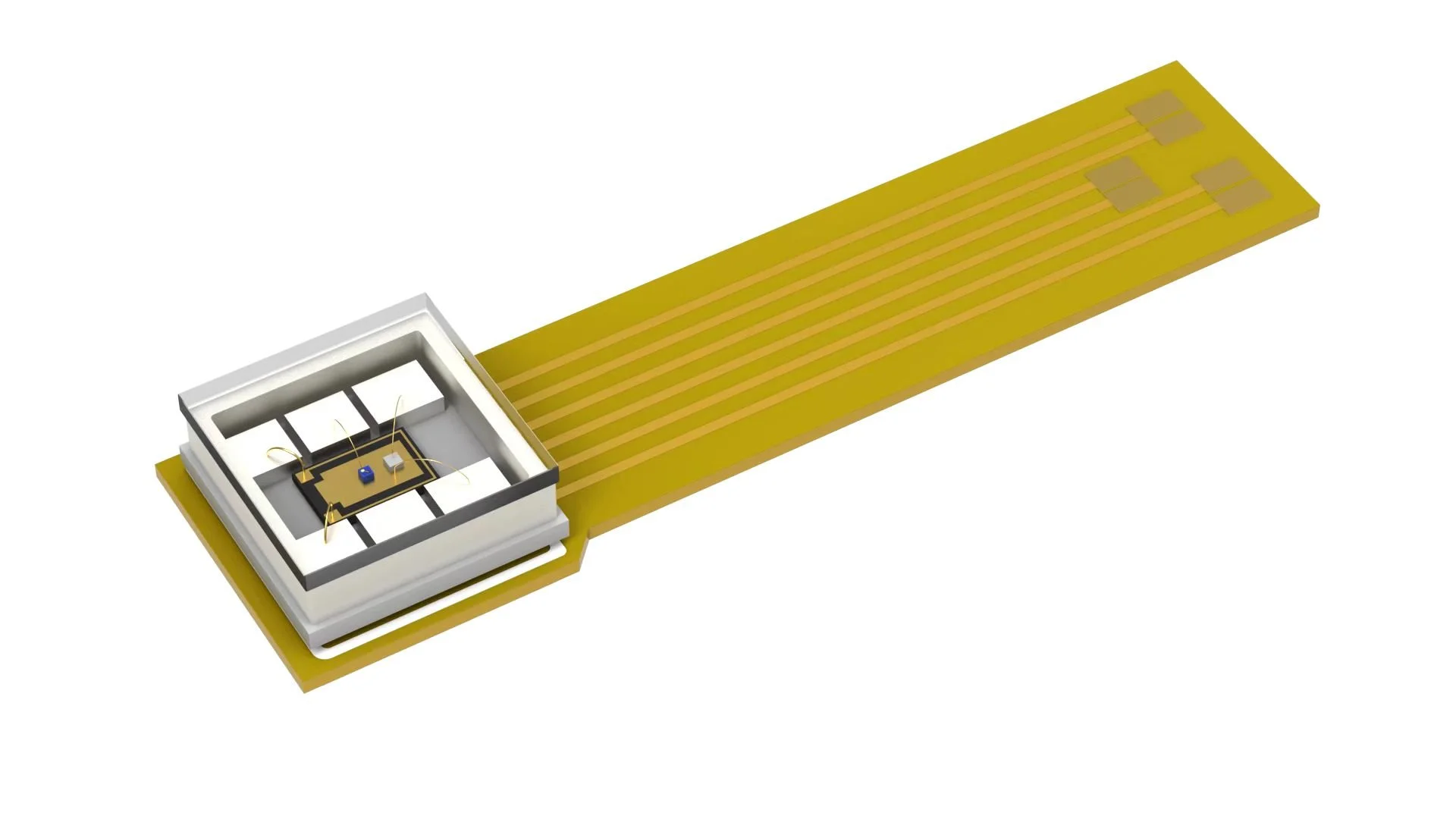
Semiatom GmbH designs and manufactures high-performance VCSEL solutions configured for advanced quantum sensing and MEG brain imaging. Recognizing that standard industrial and datacom emitters cannot satisfy quantum metrology demands, our foundry specializes in custom optoelectronic design:
Targeted Atomic Wavelengths: Epitaxial growth precision tuned to atomic absorption bands, including 795 nm and 894 nm.
Spectral Optimization: Advanced internal cavity and aperture geometries designed to yield narrow linewidths and stable single-mode performance.
Non-Magnetic Packaging: Cleanroom assembly using verified non-magnetic headers, custom submounts, and strictly nickel-free metallization.
Polarization Control: Engineered surface gratings and stress-relief designs that maintain stable linear polarization across the operating temperature range.
Whether you are building compact laboratory magnetometers or industrializing high-channel-count clinical MEG systems, Semiatom GmbH provides flexible, tailored photonics engineered to elevate sensor resolution from the ground up.
Frequently Asked Questions
Why can't standard telecommunications VCSELs be used in atomic magnetometers?
Standard telecommunications VCSELs typically operate with broad spectral linewidths (often exceeding several gigahertz) and are packed using low-cost ferromagnetic metals like nickel and Kovar. Broad linewidths fail to pump alkali atoms efficiently, while ferromagnetic packaging introduces severe magnetic interference that masks faint brain signals.
How does laser linewidth affect OPM sensor sensitivity?
Alkali gas absorption transitions are spectrally narrow. When an optical source has a wide linewidth, excess photons fall outside the target transition, generating optical phase and intensity noise instead of contributing to atomic alignment. Narrow-linewidth lasers concentrate energy directly on resonance, suppressing baseline noise and boosting the signal-to-noise ratio.
What is the difference between rubidium and cesium OPM configurations?
Rubidium-based sensors run at the 794.98nm D1 resonance, requiring higher cell temperatures 100 - 150℃ to reach SERF conditions, but they yield extremely high sensitivity. Cesium sensors operate at 894.59nm D1 and can function effectively at lower cell temperatures, slightly easing thermal insulation design at the cost of modest differences in atomic properties.
Why is polarization stability critical for the laser source?
Atomic optical pumping requires circularly polarized light to align electron spins in a single direction. If the linear polarization of the VCSEL drifts over time or temperature, the downstream circular polarization degrades, destabilizing atomic transparency and generating signal drift.
Can OPM-MEG completely replace cryogenic SQUID systems in clinical practice?
OPM-MEG is already replacing SQUID systems in pediatric, epilepsy, and functional brain mapping applications. Because OPM sensors can sit directly against the head in adaptable caps, they yield higher signal amplitudes, accommodate natural head movement, and eliminate the high maintenance and facility costs of liquid helium cryogenics.