Detecting the magnetic currents generated by human thought is an extraordinary engineering challenge. Cortical neuronal firings generate magnetic fluctuations ranging from tens to hundreds of femtoteslas—roughly one-billionth the strength of the Earth's ambient magnetic field.
For decades, capturing these minuscule signals required Superconducting Quantum Interference Devices (SQUIDs). While sensitive, SQUIDs depend entirely on bulky liquid helium dewars. These rigid cryostats keep the sensors inches away from the scalp, escalating costs while drastically attenuating signal amplitude due to the inverse-cube law of magnetic decay.
The emergence of room-temperature quantum magnetometry has changed this landscape. By replacing cryogenic baths with compact, vapor-cell-based sensors, clinical researchers can now place detection arrays directly against the skin.
The Physics Behind the Shift: SQUIDs vs. Modern Quantum Sensors
Before diving into laser specifications, it helps to understand why the industry is pivoting toward optically pumped systems.
Inside the Spin Dynamics of the SERF Sensor
To match and exceed the sensitivity of superconducting systems without cryogenic cooling, modern atomic sensors operate in the Spin-Exchange Relaxation-Free (SERF) regime.
Inside an alkali vapor cell (typically filled with rubidium-87 or cesium atoms alongside a buffer gas like nitrogen or helium), thermal motion causes atoms to collide billions of times per second. In standard environments, these collisions cause decoherence, rapidly destroying quantum phase alignment and killing measurement sensitivity.
However, when ambient magnetic noise is nullified using multi-layer mu-metal shields and compensation coils, and the cell is heated above 150°C, the physics transforms. Spin-exchange collisions begin to happen far faster than the atomic Larmor precession frequency. Under these specific conditions, the atomic ensemble enters a relaxation-free state: the spins lock together rather than dephasing, driving sensitivity down to sub-femtotesla levels
The Optical Engine: Operating Principles of an OPM Magnetometer
Light serves two simultaneous roles inside an OPM magnetometer: preparation and detection.
Optical Pumping: Resonant circularly polarized laser light illuminates the vapor, transferring angular momentum from photons to the alkali electrons. This process drives the atomic population into a single quantum state, polarizing the ensemble.
Precession: When an external magnetic field (such as a neural firing) passes through the cell, it exerts torque on the polarized electron spins, causing them to precess.
Optical Probing: The sensor tracks this precession by measuring either the absorption level or the optical Faraday rotation of the transmitted beam as it hits a photodetector.
If the incoming laser wavelength wanders by even a fraction of a picometer, or if its intensity fluctuates, the readout degrades immediately into baseline noise.
Single-Mode Stability: Mode hops cause instantaneous output spikes that resemble cardiac or neurological events, ruining sensor calibration.
Low Power Consumption: Sensor heads sit in arrays millimeters from human skin; laser drive power must remain under a few milliwatts to prevent thermal loading.
Why Standard Semiconductor Packaging Fails in Zero-Field Environments
A common pitfall in quantum sensor development occurs outside the semiconductor chip itself: the mechanical packaging.
erromagnetic materials corrupt zero-field operations in three specific ways:
Permanent DC Offsets: Remanent magnetism shifts alkali atoms out of the SERF regime, dropping the sensor out of its optimal detection window.
Thermal Gradient Drifting: As the diode warms up and cools down during operation, the magnetization of adjacent nickel pins drifts, introducing artificial low-frequency baseline artifacts.
Johnson Noise from Eddy Currents: Conducting magnetic materials generate thermal eddy currents that broadcast magnetic field noise directly into the adjacent vapor cell.
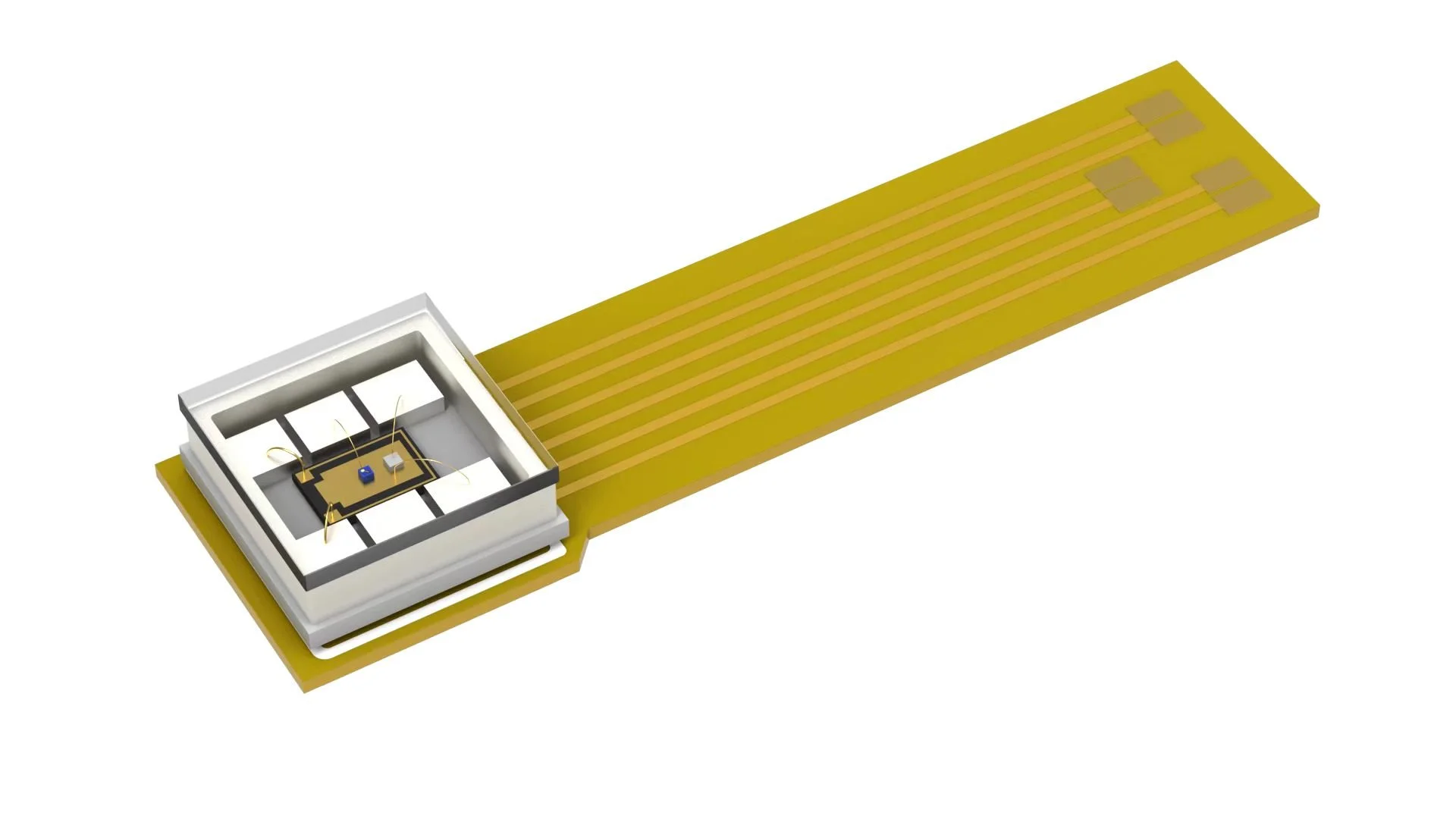
Engineering Non-Magnetic Packages for Quantum Applications
To integrate an emitter inside a modular sensor head without external fiber-optic tethering, the entire package must be rebuilt using materials with relative magnetic permeability near unity