When quantum devices transition from lab benches to field deployments, the optical source makes or breaks the architecture. Bulky external cavity diode lasers (ECDLs) and power-hungry distributed feedback (DFB) devices work well on vibration-isolated optical tables, but they fall short in portable micro-packages.
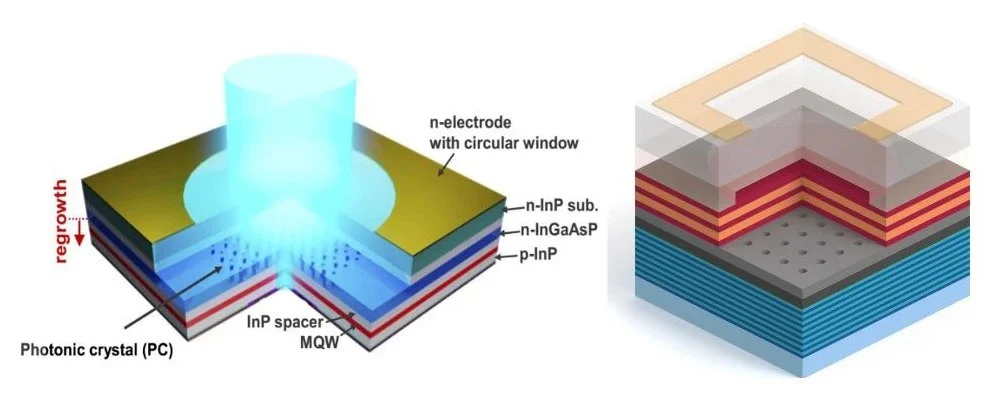
A 795 nm VCSEL offers several advantages for compact optical systems, including low drive current, near-circular beam geometry, and wafer-scale manufacturability.
At Semiatom GmbH, our custom epitaxy and packaging platforms supply single-mode 795 nm emitters tailored for interrogation of the Rubidium D1 line in timing and magnetic sensing applications.
Why 795 nm? Interrogating the Rubidium D1 Transition
Alkali vapor systems rely on precise atomic transitions to establish quantum references. Natural rubidium, containing 85Rb and 87Rb, features two principal resonance lines in the near-infrared spectrum: the D2 line at approximately 780.24 nm and the D1 line at approximately 794.98 nm.
The D1 transition, 5²S₁/₂ → 5²P₁/₂, is frequently selected for compact, buffer-gas-filled vapor cells because of its atomic structure and optical pumping characteristics.
Clean Hyperfine Energy Separation
The excited-state hyperfine splitting of the D1 transition helps distinguish optical transitions under suitable vapor-cell conditions. The actual separation depends on the isotope, buffer gas, and operating environment.
Higher CPT Resonance Contrast
Coherent Population Trapping (CPT) requires simultaneous coupling of two ground hyperfine states to a shared excited state. D1 excitation can provide favorable resonance contrast and reduced optical background in appropriately configured atomic systems.
Reduced Trapping Loss
The D1 transition offers useful optical pumping pathways that can help maintain ground-state coherence. The achievable performance depends on polarization, detuning, buffer gas, and vapor-cell configuration.
Core Performance Metrics: What Miniaturized Systems Require
Integrating a 795 nm VCSEL into a miniature physics package requires careful attention to spectral behavior, optical noise, polarization, and modulation performance.
1. Spectral Purity and Single-Mode Operation
Unwanted transverse or longitudinal modes can excite additional optical transitions and increase background noise. For demanding atomic sensing applications, single-mode operation and a high Side-Mode Suppression Ratio (SMSR) are important.
An SMSR above 30 dB may be specified for certain systems, although the required value should be verified across the intended current and temperature ranges.
2. Linewidth and Relative Intensity Noise (RIN)
Phase noise and intensity fluctuations can affect clock frequency stability through light shifts and contribute to magnetometer readout noise.
Narrow optical linewidth and low relative intensity noise help maintain stable absorption signals and improve measurement performance.
3. Polarization Stability
Optical pumping often depends on circularly polarized light, represented by σ+ or σ−.
If the laser undergoes polarization switching or changes in polarization state during temperature variations, the optical pumping efficiency may decrease.
Polarization stabilization techniques, including surface gratings and other polarization-selective structures, can help maintain the required output state.
4. Direct Microwave Modulation Efficiency
CPT-based atomic clocks require optical frequency components separated by the ground-state hyperfine splitting.
For example, modulation near 3.417 GHz can generate sidebands separated by approximately 6.834 GHz for the 87Rb clock transition.
The small active volume of VCSEL devices supports high-speed direct modulation, potentially reducing the need for external electro-optic components.
VCSEL vs. DFB vs. ECDL for Chip-Scale Quantum Devices
Selecting a suitable laser architecture involves balancing optical power, electrical consumption, spectral performance, package dimensions, and system cost.
| Laser Architecture | Threshold Current | Typical Power Draw | Linewidth | Beam Profile | Integration Suitability |
|---|---|---|---|---|---|
| Single-Mode VCSEL | < 1.5 mA | 5–15 mW | 10–50 MHz | Near-circular | Compact atomic sensing systems |
| Distributed Feedback (DFB) | 20–40 mA | 100–300 mW | 1–5 MHz | Elliptical / Astigmatic | Systems requiring narrow linewidth |
| External Cavity (ECDL) | > 35 mA | > 500 mW | < 100 kHz | Configuration dependent | Laboratory and precision spectroscopy |
Note: Values shown are illustrative rather than universal specifications. Actual performance varies with laser construction, operating conditions, control electronics, and packaging.
External-cavity lasers are useful in laboratory systems requiring narrow linewidths, while VCSELs are attractive for battery-powered instruments where compact dimensions and low electrical consumption are priorities.
Field Applications
Chip-Scale Atomic Clocks (CSAC)
Chip-scale atomic clocks provide stable local timing references for equipment operating in environments where Global Navigation Satellite Systems (GNSS) may be unavailable or unreliable.
Underwater Multilateration
Autonomous Underwater Vehicles (AUVs) can use stable onboard timing to coordinate acoustic communication and navigation without continuous access to satellite signals.
Secure Tactical Communications
Frequency-hopping communication systems depend on accurate synchronization. Compact atomic clocks can help maintain timing stability when external references are interrupted.
Geophysical Seismic Arrays
Ocean-bottom seismometers and remote monitoring stations may operate unattended for extended periods. Stable local timing is important for recording and correlating seismic events.
Optically Pumped Magnetometers (OPM)
Optically pumped magnetometers use atomic spin behavior to measure magnetic fields. Some devices operate in the Spin-Exchange Relaxation-Free (SERF) regime to achieve very high sensitivity.
Magnetoencephalography (MEG)
Magnetometer arrays can detect weak magnetic fields associated with neural activity. Compact optical sensing elements are being explored for wearable and flexible MEG systems.
Magnetocardiography (MCG)
Magnetocardiography measures magnetic fields generated by electrical activity in the heart. Optical magnetometers offer a possible route toward non-contact cardiac monitoring systems.
Sub-Surface Mineral Exploration
Magnetic sensing equipment can help identify geological structures and buried infrastructure. The selection of an atomic magnetometer depends on required sensitivity, operating field, environmental conditions, and platform constraints.
Semiatom GmbH: Custom Epitaxy and Engineering Services
Standard laser emitters do not always match the operating conditions of rubidium vapor cells. Central wavelength, tuning range, polarization, optical noise, and package dimensions must be considered together.
Semiatom GmbH develops customized 795 nm VCSEL solutions for atomic sensing and precision photonic systems, with options for bare die integration and packaged devices.
Custom Semiconductor Development
Depending on project requirements, semiconductor development and device preparation may involve the following stages:
- Custom wafer epitaxy and wavelength targeting
- Aperture engineering and optical mode control
- Wafer-level screening and spectral characterization
- Bare die preparation or packaged device integration
Precision Target Matching
Epitaxial structures can be developed for emission near 794.98 nm at a specified operating temperature.
The final wavelength must be evaluated under the actual injection current, junction temperature, and package conditions.
Wavelength Tunability
Temperature and injection current both influence the emission wavelength.
Typical VCSEL tuning behavior may be on the order of 0.06 nm/K for temperature tuning, while current tuning depends strongly on device structure and thermal operating conditions.
The available tuning range should be confirmed from device-specific measurements before integration.
Packaging Versatility
Available integration options may include:
- Bare VCSEL die for compact optical assemblies
- TO-46 packages
- Surface-mount and customized packages
- Non-magnetic packaging for sensitive instruments
- Application-specific thermal and optical components
Package selection depends on available space, thermal requirements, magnetic material restrictions, and the intended optical arrangement.
Screening and Reliability
Device screening can include optical power, emission wavelength, polarization behavior, spectral characteristics, and thermal stability.
These measurements help engineers select suitable operating conditions and assess consistency before integrating the laser into an atomic system.
Frequently Asked Questions
How do you tune a 795 nm VCSEL to match the Rubidium absorption line?
Tuning typically combines coarse temperature adjustment with fine injection-current control.
The device is brought to a stable operating temperature so that its emission wavelength approaches the rubidium D1 absorption line near 794.98 nm.
Closed-loop electronics can then use the optical absorption signal as a feedback reference to maintain the required frequency.
Why is circular polarization critical in alkali vapor cells?
Circularly polarized light can selectively excite atomic transitions where the magnetic quantum number changes by Δm = +1 or Δm = −1.
This selection behavior is important for optical pumping and atomic spin preparation. The appropriate polarization configuration depends on the sensing arrangement and transition being used.
What causes frequency drift in chip-scale atomic systems?
Important sources of drift include temperature variations, changes in optical power, and light shifts associated with interactions between the laser field and atomic levels.
Stable laser current, temperature regulation, and suitable feedback electronics help reduce these effects.
Can VCSELs withstand high-shock and high-vibration environments?
VCSELs are compact semiconductor devices that do not require the external optical cavities used in external-cavity diode lasers.
Their small dimensions and monolithic construction can simplify mechanical integration.
However, actual shock and vibration resistance must be verified at the packaged device and system levels.
What is the advantage of using bare dies over packaged components?
Bare VCSEL dies can be mounted directly onto compact optical benches or integrated with micro-electro-mechanical systems (MEMS).
This arrangement can reduce package size and shorten electrical interconnections.
Packaged devices, however, may provide additional mechanical protection and easier handling. The preferred option depends on the assembly process, thermal environment, and reliability requirements.