Your brain generates faint ionic currents every time a neuron fires. These electrical pulses create magnetic fields in the femtotesla ($10^{-15}\text{ T}$) range—billions of times weaker than the Earth’s geomagnetic pull.
Historically, capturing these tiny signals required magnetoencephalography (MEG) suites powered by Superconducting Quantum Interference Devices (SQUIDs). While SQUIDs are sensitive, they depend on liquid helium cooling ($4\text{ K}$), encasing the patient under an immovable, hundred-kilogram helmet.
Optically pumped magnetometers (OPMs) running in the spin-exchange relaxation-free (SERF) regime have eliminated the cryogenic requirement. OPM-MEG uses compact, room-temperature sensors placed directly against the scalp.
Building wearable MEG arrays introduces a distinct hardware bottleneck: the laser package itself can blind the atomic vapor cell. When the housing contains ferromagnetic elements, parasitic magnetic fields bleed into the measurement zone.
Solving this challenge demands a ground-up redesign of semiconductor optoelectronic packaging, stripping out magnetic materials to achieve pure optical pumping.
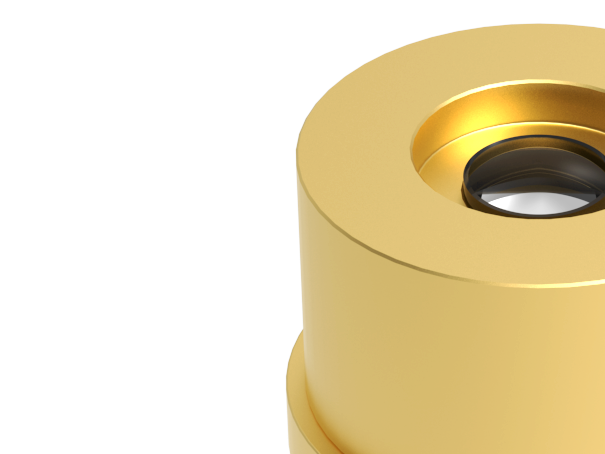
The SERF Mechanism and Optical Pumping Demands
A SERF magnetometer relies on an alkali vapor cell—typically rubidium (87{Rb) or cesium (133Cs)—heated within a low-magnetic-field chamber.
Spin Alignment: A circularly polarized beam tunes directly to the atomic D1 absorption line (795.0 nm for 87Rb or 894.3 nm for 133Cs), pumping valence electrons into a single spin-polarized state.
Precession: External biomagnetic fields from neural activity cause the collective atomic spin vector to tilt (Larmor precession).
Detection: A secondary probe beam—or the transmission shift of the pump beam itself—measures this tilt via optical rotation.
The Zero-Field Requirement
Normal alkali collisions cause spin-exchange relaxation, which broadens the resonance linewidth and degrades sensitivity. The SERF regime stops this relaxation mechanism by operating in a near-zero magnetic field (< 10 nT) with high atomic density. Collisions occur far faster than the precession frequency, forcing the atom ensemble to maintain coherent orientation.
If your light source sits 5 to 10 mm from the vapor cell and carries magnetic remanence, it introduces stray field gradients across the cell volume:
These gradients cause Zeeman splitting of atomic sublevels, broaden the magnetic resonance line, shorten transverse relaxation time (T2), and sharply increase the sensor's noise floor.
Where Standard Optoelectronic Packaging Fails
Standard commercial laser packages (such as legacy TO-can, butterfly, or ceramic surface-mount formats) are engineered for consumer electronics, industrial manufacturing, or telecommunications. In those environments, microtesla-level magnetic fields do not affect performance. In sub-picotesla quantum sensing, however, standard packaging materials cause immediate issues.
The Primary Culprits
Kovar (Fe-Ni-Co Alloy): Standard glass-to-metal seals rely on Kovar because its thermal expansion coefficient matches borosilicate glass. Kovar is strongly ferromagnetic, exhibiting high magnetic permeability and significant remanence.
Nickel Underplating: Plating specifications frequently use an electrolytic or electroless nickel barrier (2-5 µm) beneath gold surface finishes to prevent copper migration. This thin nickel layer holds active magnetic domain walls that cannot be completely degaussed.
Active Cooling Components: Conventional thermoelectric coolers (TECs) use internal nickel diffusion barriers at their bismuth telluride ({Bi2Te3) pellet junctions. When drive currents pass through these loops, they produce localized DC magnetic fields that fluctuate with thermal load changes.
Standard Packaging vs. Quantum-Grade Non-Magnetic Requirements
Metallurgy of Non-Magnetic Packaging
Removing magnetic interference requires switching to non-ferrous, low-magnetic-susceptibility (Xm) alloys across every component of the package assembly.
1. Structural Header and Cap
Phosphor Bronze (C54400 / C51000): Offers machinability, mechanical strength, and thermal conductivity with relative permeability practically equal to 1.
Titanium (Grade 5 / Ti-6Al-4V): Provides rigidity, low thermal conductivity (useful when isolating internal heated cells), and negligible magnetic susceptibility.
2. Sealing and Feedthroughs
Matched Expansion Glasses: High-integrity hermetic seals require sealing glasses matching the thermal expansion profiles of bronze or beryllium-copper pins.
Lead Geometry: Signal and ground return pins are routed in close, parallel pairs. Because current flows in equal and opposite directions, the induced Oersted fields largely cancel:
3. Die Mounting and Wire Bonding
Submounts: Aluminum Nitride (AlN) or pure silicon submounts provide electrical isolation and heat dissipation without magnetic phases.
Solders: Eutectic gold-tin (Au80Sn20) preforms deliver flux-free, stable joints.
Interconnects: 99.99% pure gold (4N Au) bonding wire replaces aluminum-ferrous alloys, avoiding inductive micro-loops during wire bonding.
Why VCSELs Outperform DFBs in Wearable Sensor Arrays
Selecting the laser architecture involves balancing spectral purity against size, thermal load, and system footprint. While external-cavity diode lasers (ECDLs) and distributed feedback (DFB) lasers are common on laboratory benches, Vertical-Cavity Surface-Emitting Lasers (VCSELs) provide distinct physical advantages for wearable OPM channels.
Optical Profile Comparison
Because a VCSEL draws only single-digit milliamps, the associated drive-trace magnetic fields stay minor.
Its circular output profile couples directly into simple micro-lenses and waveplates, fitting easily within modular footprints like the TO-46.
Manufacturing and Customization at Semiatom GmbH
Semiatom GmbH fabricates custom VCSEL components engineered for zero-field and low-field atomic spectroscopy. We control the complete production chain—from molecular beam or metal-organic chemical vapor deposition (MOCVD) epitaxy to wafer-level micro-optics and non-magnetic assembly.
Frequently Asked Questions
Why not use a standard laser diode outside the shield and route light via optical fiber?
Fiber delivery works well on optical benches, but running dozens of polarization-maintaining fibers into a 64- or 128-channel MEG helmet creates mechanical drag, microphonic phase noise, and fiber bend-loss fluctuations when the patient moves. Placing non-magnetic VCSELs directly inside each sensor channel removes optical fibers entirely, keeping the helmet lightweight and flexible.
How are non-magnetic laser packages verified for zero residual flux?
Finished packages undergo screening within magnetically shielded rooms (MSRs) using calibrated SQUID arrays or reference fluxgate sensors. Components are evaluated for both static remanent fields (dipole moments after exposure to external fields) and active inductive fields generated during continuous 1 to 5 mA forward drive currents.
Does eliminating nickel plating cause gold embrittlement or wire bond failures?
Direct gold plating over copper-based alloys can lead to copper diffusion over extended storage periods. To prevent this without using nickel, specialized non-magnetic diffusion barriers (such as pure platinum or refractory metal thin films like titanium-tungsten, TiW) are applied before final gold deposition. This maintains wire-bond stability while preventing magnetic contamination.
Can VCSELs deliver the optical power needed for multi-pass vapor cells?
Yes. Modern single-mode VCSELs reliably deliver between 0.5 mW and 3.0 mW of continuous-wave power at the Rubidium and Cesium D1 lines. Because micro-fabricated OPM cells have beam waist diameters under 2 mm, this power density is well-suited for atomic saturation without inducing unwanted power-broadening effects.
How does Semiatom GmbH handle wavelength drift across production batches?
Through precise epitaxial growth control and targeted wafer-level testing, Semiatom selects and bins dies to match alkali target bands. Incorporating small internal resistive heating elements directly on the ceramic submount lets users fine-tune the operating wavelength across several nanometers via closed-loop temperature control.