Picking up the firing of a single neuron cluster inside the human skull is like listening for a pin drop in the middle of a thunderstorm. The brain operates through microscopic ion flows across cell membranes, kicking off magnetic pulses that register in the tens of femtoteslas—roughly one-billionth of Earth's geomagnetic pull.
For decades, catching these signals meant locking patients inside multi-million-dollar magnetoencephalography (MEG) suites. You had to sit frozen beneath a half-ton liquid-helium dewar that looked like an oversized salon hairdryer from the 1970s.
That era is ending. Modern neuroimaging is going wearable, built around lightweight caps studded with micro-sensors that ride right against the scalp. At the center of this shift is the Optically Pumped Magnetometer (OPM), powered by a specialized semiconductor source: the 795nm VCSEL.
Peering into Human Thought with Quantum Magnetometry
Scanning brain function without cutting into the skull or exposing tissue to ionizing radiation is the domain of quantum magnetometry. Instead of relying on bulk inductive pick-up coils, this approach turns isolated, vaporized atoms into ultra-responsive field sensors.
From Deep-Freeze SQUIDs to Wearable Sensor Caps
For forty years, MEG ran on Superconducting Quantum Interference Devices (SQUIDs). SQUIDs work wonders, but the laws of physics are uncompromising: superconductivity demands cryogenic temperatures near absolute zero (-269°C).
To keep the sensors cold, SQUIDs sit behind thick vacuum-insulated dewar walls. That insulation leaves an unavoidable 20 to 40 mm gap between the pickup loop and the scalp. Because magnetic fields obey the inverse-square law, that air cushion eats away at signal amplitude before detection even starts.
By eliminating cryogenic plumbing, an Optically Pumped Magnetometer (OPM) brings the active measurement volume down to 2 or 3 millimeters off the skin. Cutting that distance quadruples the measured signal from superficial cortical sources, letting clinicians record high-definition brain activity that traditional SQUIDs miss.
Lighting Up Rubidium: The Physics of Atomic Coherence
How does a small glass vial filled with alkali vapor turn into an ultra-sensitive magnetic antenna? The mechanism relies on optical pumping.
Alkali metals like rubidium-87 (87Rb) carry a single unpaired electron in their outer valence shell. Left alone in the dark, these atoms point their electron spins in random directions, canceling each other out into thermal equilibrium.
Engineering Challenges in Ultra-Weak Biomagnetic Detection
Operating in the femtotesla zone changes your engineering priorities. When measuring fields that are orders of magnitude smaller than a heartbeat trace, every component in your optical chain can introduce noise.
Selecting a Low-Noise Laser Diode for Optically Pumped Magnetometers
Every micro-fluctuation in laser output power hits the photodiode directly, showing up on your readouts as artificial brain waves. A dependable low-noise laser diode for optically pumped magnetometers needs an exceptionally low Relative Intensity Noise (RIN) profile, usually better than:
Non-Magnetic VCSEL Packaging for MEG Brain Imaging
Engineers often overlook a straightforward risk: ferromagnetic contamination inside the sensor housing itself. Standard commercial laser packaging relies on kovar pins, nickel underplating, and iron-alloy headers.
Placing a kovar-pinned component 5 mm away from an alkali vapor cell causes serious problems:
The remnant magnetic field of nickel pins can reach tens of nanoteslas.
That background field swamps the 50-femtotesla signal you are trying to measure.
Stray fields induce broad field gradients, shortening spin-coherence time (T2) and killing sensor sensitivity.
Building effective non-magnetic VCSEL packaging for MEG brain imaging means stripping out standard electronics metallurgy:
Using zero-susceptibility ceramic submounts and non-ferrous housings keeps the background field quiet, so the sensor registers brain signals without distortion.
The Rubidium Vapor Cell Optical Pumping Light Source
When designing light sources for atomic magnetometers, two main semiconductor architectures compete: edge-emitting Distributed Feedback (DFB) laser diodes and Vertical-Cavity Surface-Emitting Lasers (VCSELs).
While DFB lasers deliver high optical power and narrow linewidths, they draw significant current, throw an asymmetric elliptical beam, and generate heat that is tough to manage on a patient's head.
The Edge of a 795nm Single-Mode VCSEL for Rubidium OPM
A 795nm single-mode VCSEL for rubidium OPM solves these integration headaches:
Low Power Draw: VCSELs need operating currents of just 1.5 mA to 3.5 mA, compared to 50 mA to 100 mA for equivalent edge-emitters. That lets dozens of sensor channels run on a flexible cap without turning into an uncomfortable heating pad.
Circular Beam Profile: The surface-normal emission gives you a symmetric, low-divergence circular Gaussian beam. A flat microlens and a compact quarter-wave retarder are all you need for clean circular polarization—no anamorphic prism pairs required.
Single Longitudinal Mode Operation: Because a VCSEL's resonant cavity is only a few micrometers long, its longitudinal mode spacing is far wider than the optical gain profile. This cavity design eliminates mode-hopping, keeping output locked to the rubidium absorption line.
Semiatom GmbH: Custom Semiconductor Solutions
Sensor designers building high-channel-count MEG caps cannot rely on off-the-shelf industrial parts. Operating temperatures, buffer-gas pressures, and packaging geometries vary from one OPM design to the next.
Semiatom GmbH manufactures specialized VCSEL components designed specifically for quantum sensing and precision atomic spectroscopy.
Precision Tuning from Wafer to Package
Custom Wavelength Matching: Buffer gases like nitrogen or helium inside an OPM cell shift and broaden the atomic resonance line. Semiatom GmbH adjusts epitaxial layer thickness and active quantum-well recipes during growth, ensuring your VCSEL hits 794.98 nm at your exact target drive current and operating temperature.
Polarization Control: By introducing controlled mechanical strain and asymmetric mesa geometries, we suppress transverse polarization switching. This maintains a Side-Mode Suppression Ratio (SMSR) above 30 dB across your working thermal window.
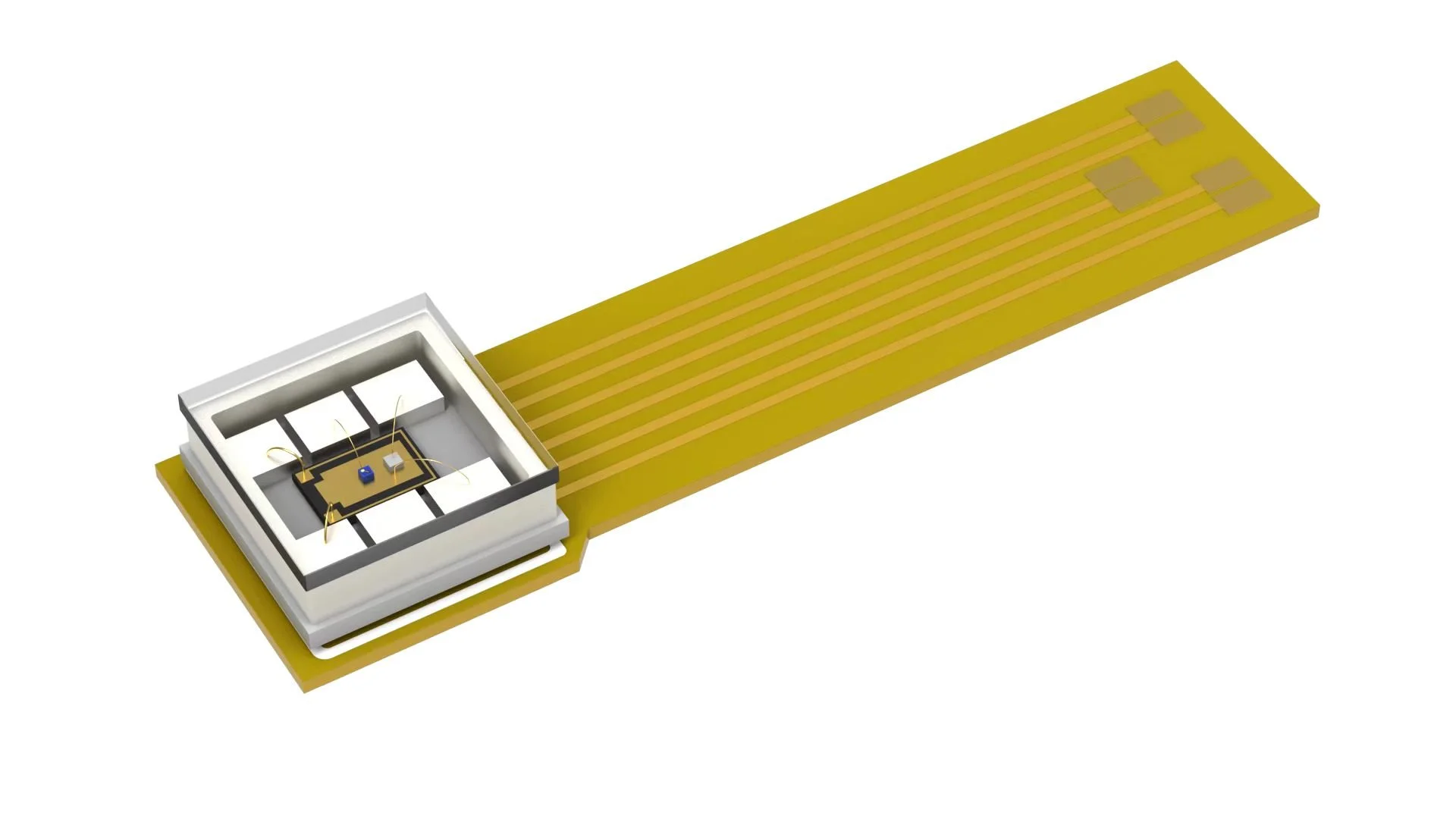
Non-Magnetic Packaging Formats: Semiatom GmbH offers non-ferrous ceramic submounts, bare-die tape-and-reel delivery for custom MEMS assemblies, and miniature TO-can outlines built with non-magnetic materials.
Clinical and Research Applications
Moving from room-sized cryogenic systems to flexible, VCSEL-driven OPM arrays opens up real-world clinical uses that used to be impossible:
Pediatric Diagnostics
Young children struggle to stay still inside traditional MEG systems, often requiring sedation. Lightweight OPM helmets adjust to any head size, letting doctors scan pediatric patients while they sit comfortably and move naturally.
Surgical Planning for Epilepsy
Mapping the precise focus of an epileptic seizure requires clean signal reads during an active episode. Wearable OPM sensors stay locked to the patient's head during physical movement, giving surgeons millimeter-level localization for resective surgery.
Moving Beyond the Brain
The same optical pumping architecture maps weak biomagnetic fields throughout the body:
Magnetocardiography (MCG): Recording fetal and adult heart dynamics without skin electrodes.
Nanoparticle Tracking: Tracing functionalized magnetic markers through tissue to monitor targeted cancer treatments in real time.
Frequently Asked Questions
Why use 795 nm light instead of 780 nm for rubidium OPM sensors?
Rubidium features two major optical transitions: the D1 line at 794.98 nm and the D2 line at 780.24 nm. While 780 nm sources are widely available, the D2 excited state contains closely spaced hyperfine levels that let atoms cycle into unpolarized ground states. The 795 nm D1 transition provides cleaner optical pumping and higher spin polarization, translating directly to a lower sensor noise floor.
How does an OPM compare to a standard clinical EEG?
Electroencephalography (EEG) tracks electrical potentials on the scalp, but those signals are smeared and distorted as they pass through the meninges, cerebrospinal fluid, and skull bone. Magnetic fields pass through human tissue with virtually zero distortion. An OPM matches the temporal resolution of EEG (sub-millisecond) while delivering the crisp spatial localization of an MRI.
What causes a VCSEL to drift off wavelength in an OPM sensor?
Wavelength drift is driven by thermal changes and current instabilities. A VCSEL shifts wavelength by roughly 0.06 nm per degree Celsius (30 GHz/K) due to thermal expansion and refractive-index changes inside the DBR mirror stack. Stable OPM operation requires high-precision current drivers along with onboard micro-thermistors and closed-loop thermoelectric coolers to lock the junction temperature within millikelvin tolerances.
Can VCSEL-based OPM sensors run outside magnetic shielding?
Current high-sensitivity OPMs—especially those running in the Spin-Exchange Relaxation-Free (SERF) regime—require a near-zero background field (typically <10 nT ) to prevent rapid spin relaxation. While they still require magnetically shielded rooms (MSRs) or lightweight dynamic field-nulling coils, wearable OPM arrays use much simpler, thinner shielding than the massive rooms required by liquid-helium SQUID systems.
What custom options does Semiatom GmbH offer for OPM developers?
Semiatom GmbH provides custom epitaxial design to match target wavelengths under specific buffer-gas pressures, polarized single-mode aperture geometries, integrated micro-optics for beam collimation, and non-magnetic packaging options (including ceramic surface-mount devices and bare die arrays for MEMS integration).