Oxygen can be measured without bringing a chemical sensor into direct contact with the gas. A laser sends light through a sample, and a photodetector records how much reaches the other side. At certain wavelengths, oxygen molecules absorb a small portion of that light. Measuring the absorption makes it possible to determine the amount of oxygen along the optical path.
A 760 nm VCSEL for oxygen sensing is well suited to this technique because its emission wavelength can be adjusted through electrical current and temperature. Its small size also makes it attractive for compact gas cells, portable equipment, and integrated optical assemblies.
There is one important detail, though: a laser labeled 760 nm will not necessarily reach the oxygen absorption line you want to measure. Its tuning range, spectral behavior, and operating conditions matter just as much as its nominal wavelength.
This article explains how oxygen absorption spectroscopy works, how VCSEL wavelength tuning affects the measurement, and what engineers should consider when selecting a laser source.
Why a 760 nm VCSEL Works for Oxygen Sensing
Oxygen has a group of absorption lines in the spectral region around 760 nm, commonly known as the oxygen A-band. These lines occur when oxygen molecules absorb photons at specific optical frequencies.
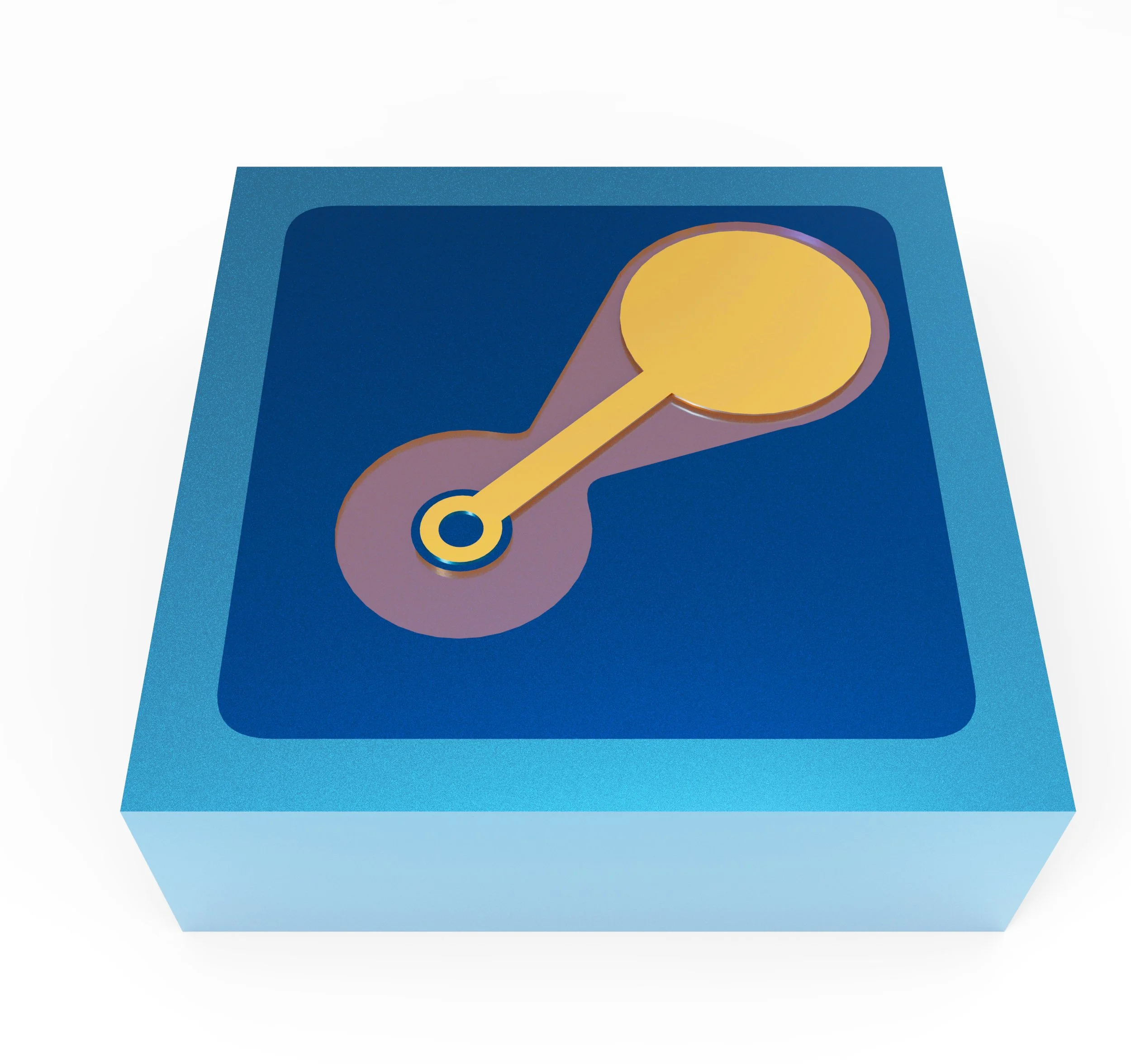
A vertical-cavity surface-emitting laser, or VCSEL, produces light perpendicular to its semiconductor chip surface. Its structure allows compact packaging and relatively low-current operation. The emission wavelength can also be shifted over a limited range without external wavelength-selecting optics.
For oxygen sensing, the main advantage is the ability to sweep a narrow laser line across an oxygen absorption feature.
Understanding the Oxygen A-Band
The oxygen A-band contains many closely spaced molecular absorption lines, extending through a region of the near-infrared spectrum around 760–770 nm.
They do not all have the same strength. Some produce stronger absorption, while others are weaker or overlap with neighboring features.
A laser operating near one of these lines can scan across it while the detector records the transmitted intensity.
When the laser reaches the absorption wavelength, less light passes through the gas. The change in transmission creates a recognizable spectral feature.
The depth and shape of this feature depend on oxygen concentration, pressure, temperature, and optical path length.
Choosing the Right Oxygen Absorption Line
Not every line in the A-band is equally useful.
An engineer selecting a wavelength should consider the expected oxygen concentration and the distance the beam will travel through the gas.
A strong line may be useful for a short optical path. A weaker line can sometimes be preferable when absorption would otherwise become too large.
Transitions near 760.24 nm and 760.89 nm have been investigated for laser-based oxygen measurement, although the exact wavelength convention must be checked.
Published line positions may be expressed in air wavelengths, vacuum wavelengths, or wavenumbers. Mixing these conventions can produce an avoidable targeting error.
The goal is to reach a specific absorption line, not simply to emit somewhere near 760 nm.
How Oxygen Absorption Spectroscopy Works
A typical optical oxygen sensor contains four main elements: a tunable laser, an optical path through the gas, a photodetector, and signal-processing electronics.
The laser beam passes through the gas sample. Oxygen absorbs part of the light at selected wavelengths, and the detector measures the remaining intensity.
By sweeping the wavelength across an absorption line, the electronics can identify the absorption feature and estimate the amount of oxygen in the beam path.
The Optical Path and Photodetector
A small collimating lens is often positioned in front of the VCSEL to direct the beam through the gas cell.
After crossing the sample, the light reaches a photodetector. Silicon photodiodes are commonly used near 760 nm because they have suitable spectral sensitivity in this region.
The photodiode converts received light into electrical current. An amplifier then converts the current into a signal that can be processed electronically.
Some optical arrangements also include a reference photodiode. This channel helps track changes in laser output power that are unrelated to oxygen absorption.
How Absorption Changes With Gas Concentration
The relationship between transmitted light and gas absorption is described by the Beer–Lambert law:
I(λ) = I₀(λ) × exp[−α(λ)L]
Here:
I₀(λ) is the incident light intensity.
I(λ) is the transmitted light intensity.
α(λ) is the wavelength-dependent absorption coefficient.
L is the optical path length through the gas.
At a given pressure and temperature, the absorption coefficient depends on oxygen concentration and the selected spectral line.
The detector measures transmitted intensity, not oxygen concentration directly. The electronics must account for the laser baseline, gas conditions, and absorption characteristics to obtain a concentration reading.
Why Optical Path Length Matters
A short gas cell may produce only a small change in received intensity, especially when oxygen concentration is low.
Increasing the distance traveled through the gas generally strengthens the absorption signal.
A multi-pass cell accomplishes this by reflecting the beam several times through the same gas volume. A relatively compact chamber can provide an effective optical path of several meters.
Longer paths are not always better. Each reflection introduces optical loss and creates opportunities for interference between reflected beams.
The path length should be selected together with the laser's available optical power and the expected oxygen concentration.
Wavelength Tuning in a 760 nm VCSEL
Wavelength tuning allows the laser to move across a narrow oxygen absorption feature instead of remaining at one fixed wavelength.
VCSELs can be tuned by changing the injection current, the operating temperature, or both.
These adjustments are closely related, but they serve different roles in a spectroscopy system.
Current Tuning: Fast and Electrically Controlled
Changing the injection current affects the laser's carrier population and internal temperature. Both can influence the emission wavelength.
In oxygen spectroscopy, current tuning is often used to scan the laser across an absorption line.
A small electrical waveform applied to the drive current can produce a repeating wavelength sweep. The photodetector records the transmitted light throughout that sweep.
Current adjustment also changes optical power. This means a change in detector output is not necessarily caused by oxygen absorption alone.
The processing electronics must distinguish the laser's natural power variation from the change produced by the gas.
The current-to-wavelength relationship is not identical for every VCSEL, and it may vary across the operating range.
Temperature Tuning: Reaching the Target Line
Temperature changes the optical properties of the semiconductor cavity and shifts the emission wavelength.
By adjusting the chip temperature, engineers can bring the laser into the wavelength region needed for a chosen oxygen transition.
Temperature tuning is usually slower than current tuning. It is commonly used to establish the operating point, while current modulation handles faster wavelength sweeps.
For applications where ambient temperature changes significantly, a thermoelectric cooler (TEC) and temperature sensor may be required.
Why the Tuning Range Must Be Checked
Consider a laser specified at a nominal wavelength of 760 nm.
If its operating range does not reach the selected oxygen absorption line, it may be unsuitable even though the wavelength printed in the catalog appears correct.
The opposite is also possible. A VCSEL with a slightly different nominal wavelength may reach the required line comfortably through current and temperature adjustment.
For an oxygen absorption spectroscopy VCSEL, usable tuning range matters more than the nominal wavelength alone.
Engineers should also check whether the laser remains single-mode throughout the intended sweep.
A transition between optical modes can distort the apparent absorption feature and interfere with accurate measurements.
Direct Absorption and Wavelength Modulation Spectroscopy
Two widely used techniques for measuring oxygen absorption are direct absorption spectroscopy (DAS) and wavelength modulation spectroscopy (WMS).
Both examine how oxygen affects transmitted laser light, but they extract the absorption signal differently.
Direct Absorption Spectroscopy
In direct absorption spectroscopy, the laser wavelength moves across an oxygen line while a photodetector measures transmitted intensity.
As the wavelength approaches the absorption center, the detector records a reduction in light.
This creates an absorption dip that can be evaluated against the surrounding baseline.
DAS is relatively straightforward to implement and can work well when the absorption signal is strong enough.
Its main difficulty is separating actual gas absorption from unwanted changes in laser intensity, optical transmission, and detector output.
Wavelength Modulation Spectroscopy
Wavelength modulation spectroscopy uses a different way of reading small absorption changes.
A periodic modulation is added to the laser drive current while the emission wavelength moves across the selected oxygen line.
The detector signal contains components at the modulation frequency and its harmonics.
Electronic demodulation can isolate these components, making weak absorption features easier to distinguish from some forms of background noise.
The second-harmonic component, commonly called 2f, is frequently used in laser gas sensing.
WMS is particularly useful when the absorption feature is small compared with changes in the optical baseline.
Understanding 2f/1f Detection
In WMS-2f/1f sensing, the second-harmonic signal is normalized using the first-harmonic component.
This helps reduce the influence of changes in received light intensity.
It is particularly helpful when the optical path experiences gradual transmission changes or laser output fluctuations.
Still, normalization does not remove every source of error. Reflections, unwanted amplitude modulation, and detector nonlinearity can influence the signal.
Choosing the modulation depth and keeping the laser within a suitable operating range remain important.
Neither technique guarantees a particular detection limit. Performance depends on the complete optical and electronic arrangement.
Choosing a 760 nm VCSEL for Oxygen Sensing
Selecting a VCSEL starts with the oxygen line the sensor needs to measure.
The laser must reach that wavelength while maintaining suitable optical power and spectral characteristics.
A device that performs well at room temperature may behave differently when installed inside a sealed enclosure or operated at a different current.
Optical Power and Single-Mode Operation
Optical power determines how much light is available after passing through the lenses, gas cell, windows, and other components.
Too little received power can make weak absorption difficult to detect. Excessive power is not necessarily useful, particularly if it introduces additional heating or exceeds the detector's preferred operating range.
Single-mode emission is also important.
A laser emitting most of its power in one dominant optical mode provides a clearer source for scanning narrow oxygen lines.
Side-mode suppression ratio (SMSR) describes how strongly the main optical mode exceeds competing modes.
For spectroscopy, the laser should maintain suitable spectral behavior at the temperatures and currents used during measurement.
Other characteristics worth checking include spectral linewidth, relative intensity noise, beam divergence, and polarization behavior.
Packaging and Electrical Connections
The package influences optical alignment, thermal behavior, and assembly.
Bare VCSEL die give manufacturers flexibility when building compact optical assemblies. They can be mounted directly onto a suitable substrate and placed close to miniature lenses.
TO-style packages provide mechanical protection and convenient electrical connections.
Custom packages may be needed when the available space, optical axis, temperature control, or mounting arrangement differs from standard configurations.
The specifications should be considered together. A well-matched laser is one that operates consistently within the intended sensor, not simply one with the highest optical power.
What Can Affect Oxygen Measurements?
Even with a suitable laser, oxygen readings can change because of conditions elsewhere in the optical path.
Some of these changes come from the gas itself. Others come from the optical components or the surrounding environment.
Pressure and Temperature Changes
Gas pressure affects the width and shape of oxygen absorption lines.
At higher pressures, collisions between molecules broaden the absorption features. Temperature changes the distribution of molecular energy and affects line strength.
A sensor calibrated under one set of conditions may produce a different reading if the pressure or temperature changes.
In equipment where these conditions vary, pressure and temperature measurements can be used to correct the calculated oxygen concentration.
Spectroscopic line parameters from resources such as HITRAN are useful when selecting an absorption line and estimating its behavior.
Unwanted Reflections and Optical Interference
Reflections between lenses, windows, or other optical surfaces can produce interference fringes in the detected signal.
These fluctuations may overlap with small oxygen absorption features.
Tilting optical windows slightly, selecting suitable surface coatings, and controlling the spacing between components can reduce unwanted reflections.
Mechanical stability also matters. Changes in alignment may alter the amount of light reaching the photodetector.
Oxygen Outside the Sample Cell
One easily overlooked source of absorption is the air surrounding the sensor.
If the laser travels through ordinary air before entering the gas cell, oxygen along that external path also absorbs light.
The detector sees absorption from the entire illuminated path, not only from the gas inside the chamber.
For compact systems with short sample cells, this contribution may become important.
Sealed optical sections, nitrogen-purged paths, or carefully arranged reference channels can help separate the sample signal from unwanted background absorption.
Where Laser-Based Oxygen Sensing Is Used
Oxygen absorption spectroscopy is useful when direct optical measurement offers an advantage over sensors that require contact with the gas.
The optical arrangement can be adapted to different gas pressures, path lengths, and equipment sizes.
Industrial Gas Monitoring
In manufacturing equipment and controlled gas environments, oxygen concentration may need to be monitored without exposing sensitive electronics directly to the process gas.
An optical sensor can send light through sealed windows while keeping the laser and detector outside the chamber.
Window cleanliness, pressure changes, and optical alignment still need attention.
Atmospheric Oxygen Measurement
The oxygen A-band is widely used in atmospheric spectroscopy.
Absorption measurements can provide information about oxygen along an optical path and, with suitable atmospheric information, help characterize the amount of air encountered by the beam.
For open-air sensing, changes in pressure, temperature, humidity, and optical path conditions must be considered.
Compact Gas Sensors
VCSELs are attractive for portable and miniature sensing equipment because they require little space and can be controlled electrically.
A small laser, collimating lens, photodiode, and gas cell can be assembled into a compact optical unit.
The available space places greater demands on packaging, alignment, and heat management.
A compact laser does not automatically produce a compact sensor, but it makes a smaller optical layout more practical.
760 nm VCSEL Options From Semiatom GmbH
Semiatom GmbH develops and manufactures VCSEL products for specialized photonic applications, including oxygen sensing and precision optical equipment.
Our product portfolio includes 760 nm and 763 nm VCSEL configurations, alongside other wavelengths used in atomic sensing and related photonic applications.
The current product listing includes a 0.3 mW optical output option for the 760/763 nm range, with bare die, TO-style, and customized packaging configurations. Actual operating characteristics depend on the selected device and working conditions.
We also work with customers whose optical or mechanical requirements do not fit a standard product configuration.
Custom VCSEL Requirements for Oxygen Spectroscopy
For a customer developing an oxygen sensor, wavelength selection is usually the starting point.
The target absorption line needs to fall within the device's usable tuning range. Optical power, operating temperature, electrical drive conditions, and package dimensions must then be considered together.
Semiatom GmbH can discuss available wavelength options, chip configurations, packaging, and application-specific requirements with customers developing oxygen spectroscopy equipment.
To make the discussion more productive, customers can provide the following information:
A simple drawing showing the laser position, optical path, and available package space can also help clarify the requirements.
Getting a Dependable Oxygen Reading
A useful oxygen sensor needs more than a laser at the correct nominal wavelength.
The source must reach the selected oxygen absorption line, maintain suitable spectral behavior during tuning, and deliver enough light through the optical path. The electronics must distinguish absorption from source fluctuations, while the sensor must account for changing gas conditions.
For engineers developing compact oxygen spectroscopy equipment, a carefully selected VCSEL provides a practical way to combine wavelength tuning with a small optical footprint.
Semiatom GmbH offers VCSEL product options and customization for customers building these systems. Choosing the absorption line first, then matching the laser and package to the working conditions, is a sensible way to begin.
Frequently Asked Questions
1. Why Is 760 nm Used for Oxygen Sensing?
Oxygen has characteristic absorption lines in the near-infrared A-band around 760 nm. A tunable laser can scan one of these lines and measure the change in transmitted light. The absorption signal can then be used to determine the amount of oxygen along the optical path.
2. Can a VCSEL Wavelength Be Tuned With Current Alone?
Current tuning can shift the emission wavelength, but the available range depends on the VCSEL and its operating temperature. Temperature adjustment is often used to bring the laser close to the selected absorption line, while current modulation provides faster scanning around that line.
3. Is Higher VCSEL Optical Power Always Better for Oxygen Detection?
No. The laser needs to provide sufficient received power for the optical path and detector. Very high output power may offer little benefit in a short gas cell and can increase thermal or electrical demands. Spectral stability and noise are often just as important as power.
4. What Is the Difference Between 760 nm and 763 nm VCSELs?
Both wavelength ranges can be used to access oxygen A-band absorption features. They may target different molecular transitions, depending on their tuning ranges. Selecting between them requires information about the intended oxygen line, pressure, concentration range, and optical path length.
5. Can Semiatom GmbH Provide Customized VCSEL Packaging?
Semiatom GmbH offers bare VCSEL die, TO-style packages, and customized packaging options. Customers can share their wavelength, optical power, operating temperature, mechanical dimensions, and electrical requirements to discuss a suitable configuration. The available customization options depend on the project and selected device.